
Abstract Pakistan’s livestock sector is highly developed, with an agricultural production structure where dairy farming plays a major role. Milk is consumed by many, contributing to the country’s food security while providing income, employment, and business opportunities to millions. Dairy production comes in different scales, from small domestic farms to large commercial operations, satisfying a significant portion of Pakistan’s dairy needs. Advancements in cattle breeding, feeding practices, veterinary care, management, infrastructure, milking technologies, and digitalization have created numerous opportunities for the dairy industry to thrive. The question “what makes the best dairy farm in Pakistan” cannot be determined by a single criterion. Various considerations can define the best dairy farm, including animal yield, health, cleanliness, proper feeding and management practices, cattle breeds, overall management practices, and technological application, among others. The best dairy farms in Pakistan engage in animal production following prudent measures that promote cattle health and encourage maximum milk production. This article discusses the features of best dairy farms, the development of dairy farming in Pakistan, the role of dairy farms in Pakistan, modern dairy practices, animal nutrition, farmhouse infrastructure, milk production and quality, technology application, and future opportunities. It also examines why the largest dairy farm in Pakistan is a relative term that should be interpreted from specific perspectives such as the farm’s scale and productivity. Introduction Dairy farming is an essential aspect of Pakistan’s agricultural economy. Livestock farming provides products directly and indirectly for the livelihood of millions of Pakistan’s citizens. At the same time, dairy products such as milk are critical to many people’s daily diet. Dairy animals such as cows and buffaloes are crucial sources of milk, meat, and other dairy products. Traditionally, dairy farming has been practiced on a small scale. Smallholder farmers rear animals and sell their produce to processors or milk buyers. However, the situation is changing as farmers develop commercial dairy operations to satisfy the rising demand for dairy products. When searching for the best dairy farms in Pakistan, one may find several farms that operate differently. For instance, some may look for the best dairy farms in Pakistan in terms of the highest yield, while others may be looking for the best dairy farms that emphasize animal health, cleanliness, and advanced technologies. Therefore, there is no absolute answer to what makes the best dairy farm in Pakistan. Instead, the best dairy farms are those that emphasize proper animal husbandry and management practices to ensure high-quality milk production. Dairy Farming in Pakistan Pakistan has had a thriving agricultural economy with substantial livestock numbers, contributing to dairy production for local consumption. The country’s agro-based economy has enabled it to develop robust dairy production methods while emphasizing improved dairy products for local and international markets. Livestock farming and dairy production involve various aspects, ranging from animal health and nutrition to milking technologies and management practices. What Makes the Best Dairy Farm in Pakistan? Generally, the best dairy farms are those that ensure proper animal management throughout various stages while emphasizing key production aspects, such as animal health and nutrition, farm infrastructure, milk production and quality, and modern technologies. First, animal health and management are essential components of dairy farming. Healthy cows and buffaloes are likely to yield high-quality products throughout their productive lifespan. Farmers should invest in adequate veterinary services to maximize production while minimizing the risk of disease transmission. Disease control and vaccination programs are vital in preventing and managing various illnesses affecting dairy animals. Second, a farmer must ensure proper nutrition to maintain high agricultural production. A balanced diet enables dairy animals to gain weight, reproduce faster, resist diseases, and yield high-quality milk. Farmers should provide their animals with adequate amounts of energy, protein, minerals, and vitamins in relation to their breed, age, weight, and milk production rate. Water is also a crucial component of animal nutrition as it facilitates various physiological functions in animals. The farmhouse infrastructure is another critical aspect of dairy farming. Farmers should provide their cows and buffaloes with enough space to prevent the spread of diseases and infections. Additionally, animals need adequate space to ensure good air circulation, especially in hot climates, such as in Pakistan. Farmers should also install fans or other ventilation systems to reduce the risk of heat stress, particularly for lactating cows. Milk production and quality should also be considered in determining the best dairy farms. The quality of milk is closely related to animal health conditions and farm management practices. Farmers should ensure proper hygiene and use suitable equipment when handling milk and feed to avoid contamination. Record management is also an essential aspect of modern dairy farming. Farmers should maintain proper farm management records to help them track and predict trends, such as the amount of milk produced, the number of animals, and the amount of feed required. Spreadsheets have become crucial in maintaining digital farm management records. Finally, the best dairy farms incorporate modern technologies to increase production while maintaining high-quality standards. These technologies can include milking machines and software systems that help in monitoring and managing animal health and productivity. Milking machines allow farmers to extract milk faster while reducing the risk of infections. Additionally, modern technologies enable farmers to monitor and control various farm activities, such as animal nutrition, breeding, and reproduction. Best Dairy Farms in Pakistan The best dairy farms in Pakistan can take different forms depending on farmers’ preferences, objectives, and financial status. For instance, some commercial dairy farms specialize in commercializing milk, while others focus on breeding dairy animals. Additionally, some dairy farms engage in processing and marketing dairy products. A commercial dairy farm usually has a well-organized management system that helps the farmer keep track of all activities while maximizing production. For instance, farmers usually subdivide their animals into different groups depending on their status, such as lactating cows, heifers, dry cows, and non-lactating cows. Each group has specific nutritional and management requirements that farmers should consider. Modern dairy farms also emphasize the importance of choosing animal breeds based on several
9 Dairy Farm Fan in Pakistan: Complete Guide, Prices, Types, Benefits and Buying Tips Pakistan
Introduction Comfortable conditions are one of the most important preconditions for successful dairy farming. In Pakistan, dairy farmers are frequently exposed to extreme heat, especially during the summer months. Cows and other livestock can have serious problems in severe heat and humidity because they cannot keep their normal body temperature. This condition, better known as heat stress, can have a negative effect on feed intake, milk production, fertility and overall animal performance. One of the most practical solutions is to install a dairy farm fan. They are used in cattle sheds, dairy barns, livestock farms and other agricultural buildings to enhance air movement and help animals stay comfortable. If you’re a fan of dairy, these aren’t your average household fans. Dairy fans are designed to move a large volume of air over a relatively larger area. With farmers becoming more aware of the importance of proper ventilation for the productivity of animals, the demand for dairy fans in Pakistan is increasing. Good ventilation will get rid of the hot, damp air, increase the movement of fresh air, reduce bad smells and make the inside of the dairy shed a healthier place. This guide contains all the necessary information that a farmer needs to know before buying a dairy farm fan in Pakistan. The guide discusses types, benefits, key specifications, installation, maintenance and factors affecting the price of a dairy farm fan. Dairy Farm Fan Pakistan – Complete Guide, Prices, Types, Benefits and Buying Tips – All About Dairy Farm Fans in Pakistan Introduction Comfortable conditions are one of the most important requirements of a successful dairy farm. Dairy farmers in Pakistan are frequently exposed to high temperatures, particularly during the summer months. Extreme heat and humidity can cause serious problems for cows and other livestock because they can’t regulate their normal body temperature. This condition is better known as heat stress which can reduce feed intake, milk production, fertility and overall animal performance . The simplest solution is to install a fan from a dairy farm. They are used in cattle sheds, dairy barns, livestock farms and other agricultural buildings to promote air movement and keep animals comfortable. Dairy fans are not household fans. Dairy fans are built to move a lot of air across a wide area. Pakistan is seeing an increase in demand for dairy fans as farmers are becoming more aware of the relationship between proper ventilation and animal productivity. A good ventilation system will remove the hot humid air and replace it with fresh air, it will also reduce bad smells and create a healthier environment in the dairy shed. This guide will provide a farmer with all the information that he/she needs to know before buying a dairy farm fan in Pakistan. The guide covers the types, benefits, key specifications, installation, maintenance and price influencing factors of a dairy farm fan . How a Dairy Farm Fan Operates A dairy fan functions by generating air movement in the farm building. The motor turns the fan blades . The blades push and pull air in the area . Agricultural fans are designed to move large volumes of air. They don’t cool an entire building like an air-conditioning system does, but instead they mainly enhance the movement of air around the livestock. This is a key distinction. A dairy farm fan does not necessarily lower the air temperature. Instead, it enhances air circulation, helping animals to better shed heat. The overall cooling effect can be much stronger if you combine fans with suitable ventilation and water-based cooling systems. Big Types of Dairy Fans There are different types of fans used in dairy farms. The choice depends on the size of the shed, the number of animals, the design of the ventilation system, the availability of electricity and the budget. 1. Dairy Fans, Wall Mounted Wall mounted fans are attached to walls of dairy sheds. These are useful for farmers who want to direct airflow through specific areas. Benefits include: • Installation is easy • Efficient use of floor space • Good air flow direction • Easy maintenance • Good for many cattle sheds Wall-mounted models can be especially useful for smaller and medium-sized dairy farms. 2. Dairy Fans Ceiling Mounted Fans are installed above the animals, mounted in the ceiling They can deliver air down and across a good part of the shed. These fans are often appropriate for large barns with limited floor and wall space. 3. HVLS Dairy Fans HVLS means High Volume Low Speed. These fans are characterized by large blades and slow rotation but moving a very large volume of air. HVLS fans are commonly used in large dairy barns because one large unit can move air over a large area. Benefits may include: • Wide Coverage Area • Reduced operating speed • Air movement • Less need for multiple small fans in some applications • Suitable for big agricultural buildings But they may cost more to buy and install in the first place. 4. Extraction fans Exhaust fans remove hot, stale, humid and unpleasant air from the building. Often they are combined with fresh-air openings or other ventilation systems.5. Fans for circulation • Able to move a large volume • Enduring • Cleans easily Key Specs to Look Out For Farmers should check the specifications of the d farm fan in Pfully before buying it. Top specs include: Air flow: Typically measured in cubic feet per minute ( CFM ) or cubic meters per hour . More airflow usually means more air movement, but the amount you need depends on the building. Motor power: The motor’s performance and its electricity consumption depend on its size. Blade size Larger blades can move more air, depending on design and motor performance. Speed: Some fans have speeds that are adjustable so farmers can change the airflow depending on the weather. Construction: Galvanized steel, stainless steel and long-lasting coated materials offer a better resistance to agricultural conditions. Noise level: High noise levels may disturb animals and
7 Amazing Dairy Farm Shed Design Ideas for Modern Cattle Farms
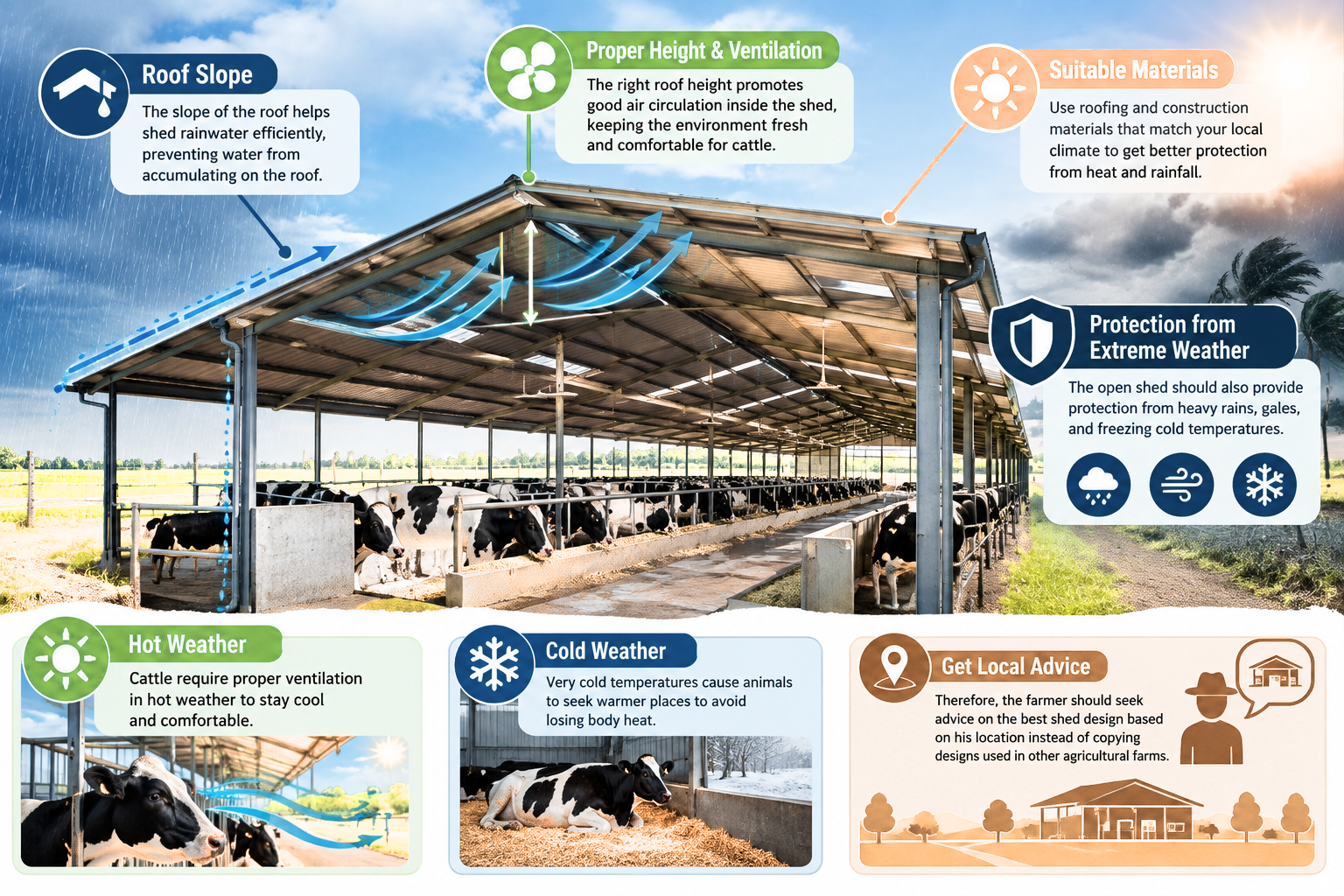
Introduction A well-planned dairy farm shed design is essential for successful dairy farming. Not only is it a shelter for the cattle, but it is their home away from home, where they spend a good amount of their time walking around, resting, feeding, and drinking. Thus, the design should be focused on animal comfort, cleanliness, ventilation and drainage, safety, and ease of operation and management. Modern dairy farming is not just about the expansion of the herd. More and more often, dairy farmers are forced to optimize all processes, including those related to the housing of animals, keeping them in good condition, and maintaining comfort and safety. Thus, a good dairy farm shed design will help to organize farm work, speed up cleaning, and provide proper care for animals in terms of feeding, watering, and protecting them from the elements. Above all, attention should be paid to the size and layout of the dairy farm shed in relation to the size of the farm and the number of animals. Although it might seem that there are universal standards for constructing such a structure, in reality, everything is relative. A small dairy farm will have different requirements than a large commercial farm. The design should fall under the specific needs of the cattle and provide enough space for feeding, resting, milking, and storage. Separate partitions for animals, storage rooms, and composting pits should also be taken into consideration. The seven ideas below are key points and guidelines for designing a functional and comfortable dairy farm shed for cows or other animals. From simple structures or open-air constructions to more modern and well-equipped ones, every farmer can find something for them or their business. Modern Dairy Farm Shed Design A Contemporary Farm Building Plan for Animal Research Paper A contemporary farmer’s design for a building to house animals is primarily focused on two things: making the cows comfortable and enabling the farmer to complete their daily tasks with ease. These tasks typically include feeding, cleaning, watering, and other cow-care duties. Ventilation is the first priority when it comes to the modern cow shed. The air needs to circulate on its own and make the building comfortable for the cows to be in. It can get quite hot inside the building, especially during the summer months because of the lack of proper airflow. The simplest way to ventilate the cows’ shed is to have it open at certain points and have windows as well as raised roof ends, so the warm air can escape. It is also important that your building has access to natural lighting, but make sure that the cows are not exposed to direct sunlight, as it can make them uncomfortable. You can achieve this by having the roof of the building high enough, as well as openings in its structure. Space is another critical factor when building a cow shed. The animals need the space to stand and lie down comfortably, as well as eat and drink. It is also vital to leave enough space so you can clean the cow sheds without any difficulty. Crowding cows will make them uncomfortable and stressed and subsequently result in lower yield. Flooring is also a significant aspect of building a contemporary cow shed. It needs to be durable, non-slippery, sturdy enough, and resistant to cow dung and water. Contemporary farmers can build a functional cow shed using simple architectural design and materials. Above all, a farmer should prioritize making the cow comfortable in the enclosure, as well as making it easier to maintain, clean, and provide access to food, water, and light. Open Dairy Farm Shed Design An open dairy farm shed design can be ideal for farms located in regions where natural ventilation is critical. The open design allows for free circulation of air through the structure, thus reducing heat buildup inside the shed. A well-planned roof design can protect animals from sunlight and rain while allowing free circulation of air inside the structure. The slope of the roof can aid in shedding off rainwater, while its height can offer good air circulation. Farmers can use materials that are suitable for the local climatic conditions to offer better protection from heat and rainfall. The open shed should also provide protection from extreme weather conditions such as heavy rains, gales, and freezing cold temperatures. Cattle require proper ventilation in hot weather, while very cold temperatures cause animals to seek warmer places to avoid losing body heat. Therefore, the farmer should seek advice on the best shed design based on his location instead of copying designs used in other agricultural farms. The location of water and feeding stations also plays an essential role in dairy farm design. The stations should be easily accessible to the animals and located in easily cleaned and reachable places. Feeding and watering structures should also allow sufficient space for farmers to conduct their daily chores. An open shed can provide a suitable link between the covered lying area and an open-air movement area that offers animals comfort while allowing them to move freely. Low-Cost Dairy Farm Shed Design Not all farmers have the financial capacity to construct a multi-level building. Low-cost dairy farm shed design can be a great option for small and medium-sized dairy enterprises. The primary objective of low-cost construction should not be to sacrifice the quality of the structure for the sake of reducing expenditures. The main idea is to optimize the inputs and spend the least amount of money possible for reliable construction without compromising the comfort of animals. The process of designing a low-cost farm should begin with the establishment of priorities. The number of cows directly impacts the size of the farm. Thus, it is of paramount importance to define how many cows the farmer will be able to accommodate within the structure. In addition, it is essential for farmers to plan the location of the feeding area, the placement of the manure pit, the drainage system, and

Farm Fan in Punjab Dairy –10 Best Dairy Farm Fans & Ventilation Cooling System
Abstract Punjab is one of Pakistan’s most important agricultural and dairy-producing regions, where livestock farming plays a significant role in the rural economy. Dairy farmers continuously work to improve milk production, animal health, farm hygiene, and overall operational efficiency. However, one of the biggest challenges faced by dairy farms in Punjab is the extreme heat experienced during the summer months. High temperatures, humidity, poor air movement, and inadequate ventilation can create an uncomfortable environment for cattle and may negatively affect their productivity. A reliable Farm Fan in Punjab Dairy can be an important part of an effective livestock ventilation and cooling strategy. Properly selected and strategically installed fans help improve air circulation, remove hot and stagnant air, and provide a continuous flow of fresh air inside the dairy shed. Farm Fan in Punjab Dairy, In larger farms, mechanical ventilation can also be combined with sprinklers, misting systems, and other cooling technologies to create a more comfortable environment for animals. Modern dairy farming requires more than simply providing food and water to livestock. Environmental management has become an essential part of successful dairy production. Temperature control, air quality, humidity management, and ventilation can all contribute to better animal comfort and farm efficiency. For this reason, choosing the right Dairy Farm Fans in Punjab should be considered an important investment rather than an optional addition. This guide explains the importance of dairy ventilation, the role of farm fans, how a Dairy Farm Cooling System works, what farmers should consider when selecting the Best Fans for Dairy Farms in Punjab, and how a properly designed ventilation system can support modern dairy farming in Punjab. Introduction Dairy cattle require a comfortable and well-ventilated environment to maintain normal behavior and productive performance. While farmers have traditionally relied on natural ventilation through open-sided sheds, doors, windows, and roof openings, these methods may not always provide sufficient airflow during extremely hot weather. The problem becomes more noticeable when temperatures remain high for long periods. Cattle generate body heat naturally, and this heat must be dissipated into the surrounding environment. When the air inside a dairy shed becomes hot and stagnant, animals can experience increased thermal discomfort. Poor ventilation can also allow moisture, dust, odors, and other airborne contaminants to remain inside the building. This is why ventilation has become an important consideration in modern dairy farm design. A properly installed Farm Fan in Punjab Dairy can improve the movement of air around the livestock area and support a better indoor environment. Fans do not simply “blow cool air”; their primary function is to increase air movement ,Farm Fan in Punjab Dairy. When air moves across the body of an animal, it can improve the cooling effect and help animals cope with hot conditions more effectively ,Farm Fan in Punjab Dairy. For farmers operating dairy units in Punjab, the selection of suitable fans should be based on several factors, including shed dimensions, herd size, roof height, natural ventilation, airflow requirements, electricity availability, and the overall cooling strategy. A successful ventilation system is therefore a combination of the right equipment, correct placement, suitable building design, and proper maintenance. Why Dairy Farm Ventilation Matters in Punjab Punjab has a climate in which summer temperatures can become a serious challenge for livestock operations. Dairy farmers need to pay particular attention to environmental conditions when managing high-producing animals because productive cattle generate considerable metabolic heat. When the surrounding environment becomes excessively warm, cattle may alter their normal behavior. They may spend more time standing, reduce feed intake, seek shaded or better-ventilated areas, and show signs of discomfort. Such changes can create challenges for farmers who are trying to maintain consistent dairy production. Ventilation helps address part of this problem by continuously moving air through the building. Good ventilation serves several purposes. First, it helps prevent hot air from becoming trapped inside the shed. Second, it supports the removal of moisture generated by animals, water systems, and cleaning activities. Third, it helps reduce the accumulation of unpleasant odors and airborne particles. Finally, increased air movement can improve the cooling effect around the animals. This makes Farm Ventilation Fans in Punjab particularly useful for dairy facilities that experience insufficient natural airflow. The objective should not be to make the entire building cold in the same way as an air-conditioned room. Dairy ventilation is primarily about maintaining suitable air movement and managing heat. The system should encourage fresh air to enter the building while helping stale and warmer air leave. The design of the shed plays an important role as well. Open-sided structures can benefit from natural airflow, but fans can strengthen and control air movement when natural wind is insufficient. In more enclosed facilities, mechanical ventilation can become even more important. Farmers should therefore consider ventilation during the planning stage of a dairy facility ,Farm Fan in Punjab Dairy. Installing fans after construction is possible, but designing the shed around airflow requirements from the beginning can often provide better results. Understanding Dairy Farm Fans in Punjab Dairy Farm Fans in Punjab are generally used to increase air movement within livestock housing areas. Different types and sizes of fans are available for agricultural applications, and the appropriate option depends on the design and requirements of the individual farm. The most important performance factor is airflow. A fan should be capable of moving an appropriate volume of air for the area in which it is installed. Simply choosing the largest or most powerful fan is not necessarily the best approach. For example, a small dairy shed with a limited number of animals may require a different ventilation arrangement from a large commercial facility containing hundreds of cattle. Farm Fan in Punjab Dairy , the height and width of the shed, the distance between animals and fans, and the availability of air inlets all influence how effectively air will move. Fan positioning is equally important. If fans are installed too high, too low, too close together, or in the wrong direction, the airflow pattern may become

Dairy Farm Business: 9 Essential Dairy Farm Business Plan Steps for Success
Introduction Starting a dairy farm business can be a chance for people who want to build a long – term farming venture. Milk is used every day. There is usually a steady market for fresh dairy products. Running a dairy farm is not as simple as buying a few cows or buffaloes and selling their milk. It needs planning, investment, animal care, feeding, hygiene, marketing , and good financial management. Many new farmers think the key is to buy animals. In truth , the success of a dairy farm depends on how well the animals are managed. Healthy animals, nutrition, clean housing, good – quality milk, and controlled expenses can make a big difference to the farm income. A small dairy farm can also become successful if it is run carefully. You do not have to start with a large herd. Beginning at a smaller level lets you learn your local market, manage animals, control costs, and build a loyal customer base before you grow. This guide explains the areas you should think about before starting a dairy farm. It also covers nine steps in a dairy farm business plan: market research, farm setup, animal selection, feeding, health management, milk production, marketing , and financial planning. Understanding the Dairy Farm Business A Dairy Farm Business is a business where animals are raised mainly for milk production. Cows and buffaloes are common in parts of the world , and goats and other dairy animals also play an important role in some markets. The basic idea seems simple: raise animals , care for them, they produce milk, and sell that milk to customers. Behind this simple idea is a daily system that must run well. Animals need food and clean water every day. Their health must be monitored , and their housing must be cleaned often. Milk must be collected and handled hygienically. The Dairy Farm Business also has a financial side. The Dairy Farm Business must pay for feed, labor, veterinary care, electricity, transportation , equipment, and other costs. If these costs are not kept low, high milk production alone may not bring a profit. This is why dairy farming must be seen as a business, not just an agricultural activity. Before starting , ask yourself some questions. Where will you sell the milk? How much will the animals cost? What will you feed them? How much will the farm cost to run each month? Who will care for the animals? What will happen if an animal becomes sick, or if milk prices change? Answering these questions early can save you from mistakes later. Why Dairy Farm Business Can Be a Good Business Opportunity One of the attractions of a dairy farming business is the regular nature of milk production. Unlike some businesses that depend on harvesting a crop once or twice a year, dairy farms can generate income on a more continuous basis. demand for milk can also come from different types of customers. Some farmers sell directly to families in communities, while others supply milk to shops, restaurants, hotels, milk collectors, or dairy processing companies. Another advantage is that a dairy farm can potentially have more than one source of income. Besides milk, farmers may earn from calves, breeding animals, manure, and other dairy products. The importance of these sources depends on the size and type of the farm. There is also room for growth. A farmer may start with a number of productive animals and increase the herd as experience and finances improve. This approach can be easier to manage than investing a large amount of money in a big farm from the beginning. However , dairy farming is not a business where income is guaranteed. Feed prices, animal health, milk prices, weather, and market conditions can all affect profitability. Good planning is therefore essential. 9 Essential Dairy Farm Business Plan Steps for Success A successful farm normally starts with a plan. The following nine steps can help you organize your idea before putting your money into the business. Research the Local Dairy Market Market research should be the first step because there is little value in producing milk without having a reliable way to sell it. Before buying animals , visit the market and talk to potential customers and milk buyers. Find out what type of milk is in demand and how much buyers are currently paying. Prices can vary from one area to another. It is better to use local information instead of relying on general estimates from the internet.You should also look at dairy farms in the area. This does not mean you need to copy them. Instead , learn how they operate and identify opportunities that they may not be serving. For example , some farms may sell milk to collectors, while another farmer might find an opportunity in delivery to households. Restaurants and small food businesses may also need a milk supply.Your target customer will influence every other part of your business. If you want to sell to families , you may need better packaging and delivery arrangements. If you plan to sell to a buyer, you may need to meet specific quality and volume requirements. A little market research before starting can prevent problems after the animals have already been purchased. 2. Prepare a Realistic Dairy Farm Business Plan The next step is to turn your idea into a dairy farm business plan . Your plan does not have to be complicated. It should simply explain how the farm will run and where the money will come from and go. Begin by estimating the amount of money you can invest. Then calculate the costs of animals, land, housing, equipment, feed, labor, transportation, and other startup needs. A common mistake is to spend most of the capital on animals and leave too little money for feed and daily expenses. Animals are the beginning. Once they are on your farm , they need to be fed and cared for every day, whether milk prices are high or low. Your business plan should , therefore, include working capital. This is the money you keep available for operations and unexpected expenses. You should also estimate your expected milk production. Be more realistic than using the highest production figure you hear from an animal seller. Actual production depends on
Best Dairy Farm in Pakistan: 7 Top Farms Revealed
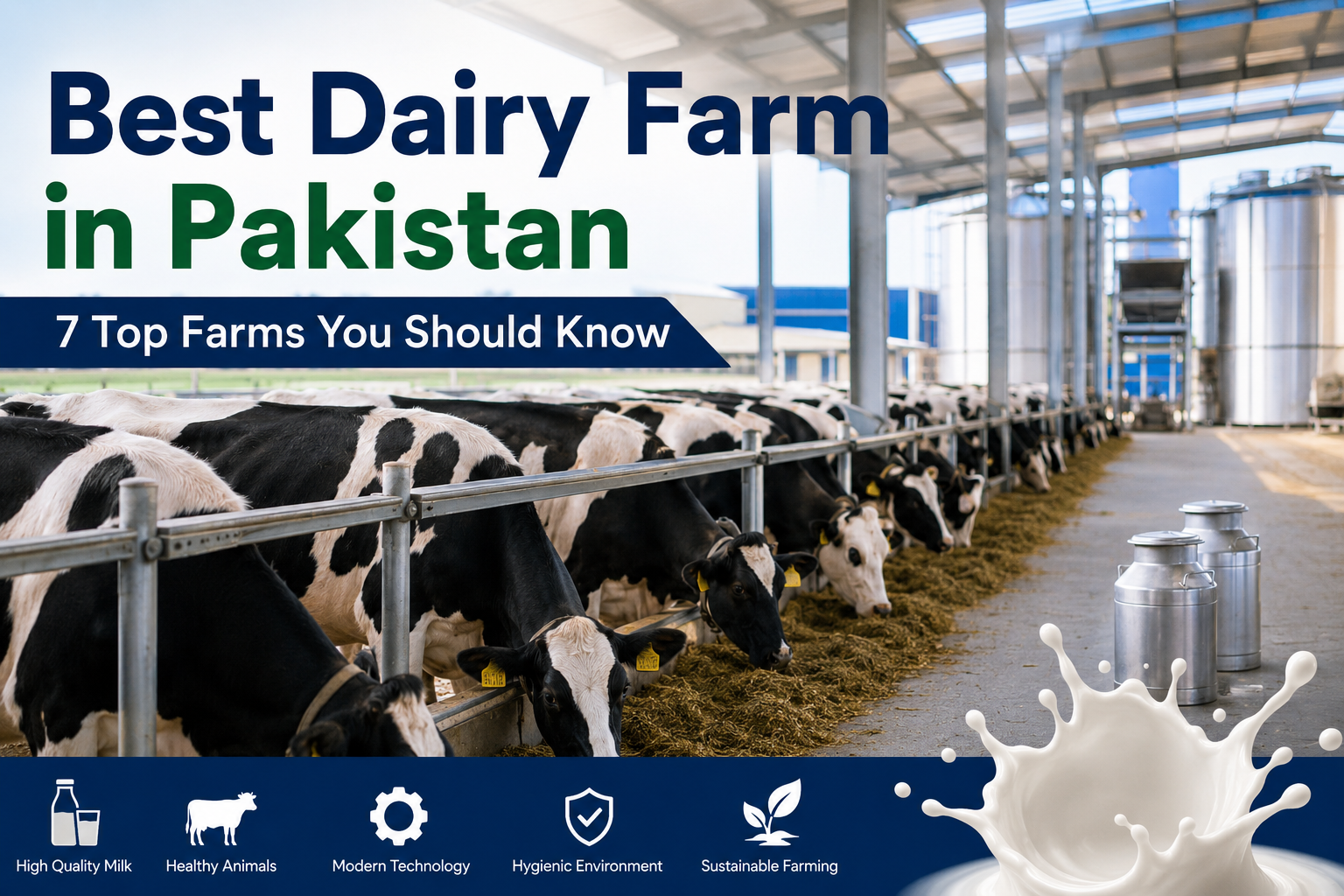
Best Dairy Farm in Pakistan: 7 Top Farms You Should Know Pakistan has a strong dairy farming industry that supports millions of families and businesses. Milk is an important part of the daily diet, while dairy products are used across homes, restaurants, and food companies. As demand for fresh and quality milk continues to increase, modern dairy farms are becoming more important in the country. Finding the best dairy farm in Pakistan is not only about the size of a farm. Milk quality, animal health, hygiene, feeding practices, and modern farming methods also matter. A well-managed dairy farm can produce better-quality milk while maintaining healthy conditions for its animals. In this guide, we will discuss what makes a dairy farm successful and look at different types of leading farms found across Pakistan. This information can help readers understand the important features of professional dairy farming. What Makes the Best Dairy Farm in Pakistan? The best dairy farm in Pakistan usually combines good animal care with efficient farming practices. A successful farm gives proper attention to the health, nutrition, comfort, and cleanliness of its dairy animals. Healthy animals are more likely to produce consistent quantities of quality milk. Milk production also depends heavily on proper nutrition. Dairy cattle need a balanced diet containing essential nutrients, minerals, and clean drinking water. Professional farms carefully manage feeding routines to support animal health and milk production. Farm hygiene is another important factor. Clean barns, milking areas, feeding equipment, and water sources help maintain better sanitary conditions. Regular cleaning can also reduce the risk of contamination and support healthier animals. Modern technology can further improve dairy farming operations. Some farms use automated milking systems, temperature monitoring, animal identification systems, and modern cooling equipment. These technologies can help farmers manage larger herds more efficiently. Animal welfare is equally important. Good dairy farms provide adequate space, ventilation, shade, and comfortable resting areas. Proper veterinary care is also necessary to identify health problems and maintain the overall condition of the herd. 7 Top Dairy Farms in Pakistan Pakistan has many dairy farms operating at different scales. Some focus on commercial milk production, while others use modern technology and improved livestock management systems. The top dairy farms in Pakistan generally share several characteristics, including better animal nutrition, hygiene, professional management, and consistent milk production. 1. Leading Dairy Farm in Pakistan A leading dairy farm normally focuses on producing quality milk through organized livestock management. Such farms usually maintain proper feeding schedules and regular veterinary supervision. Their operations are designed to keep animals healthy while maintaining stable milk production. Large dairy operations may also have dedicated areas for feeding, milking, animal care, and milk storage. Proper organization allows workers to monitor animals and manage daily farm activities more effectively. The reputation of a leading dairy farm can also depend on milk handling. Fresh milk should be collected, stored, and transported under suitable conditions. Proper handling helps preserve freshness and reduce the possibility of contamination. 2. Modern Dairy Farm in Pakistan A modern dairy farm in Pakistan often uses technology to improve productivity and animal management. Modern equipment can make several farming tasks faster and more organized. Milking technology is one example. Automated or improved milking systems can help farmers manage the milking process efficiently. Cooling equipment can also help maintain milk quality after collection. Modern farms may use digital records to monitor individual animals. Information about feeding, health, breeding, and milk production can help farmers make better management decisions. Technology alone, however, does not make a farm successful. It works best when combined with trained workers, good animal care, proper nutrition, and effective hygiene practices. 3. Large-Scale Dairy Farm Large-scale dairy farms manage bigger herds and require carefully planned operations. These farms need sufficient feed, water, housing, workers, equipment, and veterinary support. Managing a large herd requires regular monitoring. Farmers need to observe animals for changes in health, eating habits, and milk production. Early attention to problems can help prevent larger issues. Large farms can also benefit from economies of scale. When feeding, milking, storage, and transportation systems are properly organized, large quantities of milk can be handled more efficiently. 4. Quality Milk Production Farm Quality milk production begins with healthy animals and good farm management. A dairy farm cannot consistently produce quality milk without maintaining proper animal nutrition and hygiene. Clean milking equipment is especially important. The areas where milk is collected should be maintained carefully to reduce contamination risks. Milk should also be handled and stored appropriately after collection. The quality of animal feed also influences dairy production. Farmers commonly provide combinations of forage, grains, minerals, and other suitable feed according to the needs of their animals. 5. Commercial Dairy Farm Commercial dairy farms operate mainly to produce milk for the market. These farms need efficient systems because their income depends on maintaining regular production and managing operational costs. Commercial farms may serve milk processors, retailers, local markets, or other businesses. Their success depends on consistent production, responsible animal management, and effective business planning. A professional commercial dairy farm also needs reliable workers. Employees must understand feeding, cleaning, milking, animal handling, and basic livestock care procedures. 6. Sustainable Dairy Farm Sustainable dairy farming focuses on using resources responsibly while maintaining productive operations. Water management, feed efficiency, waste management, and energy use can all influence the sustainability of a farm. Some dairy farms use manure as organic fertilizer for agricultural land. Others may explore renewable energy solutions to reduce dependence on traditional energy sources. Sustainability can also benefit animals and farmers. Efficient resource management may reduce unnecessary costs while supporting long-term farm productivity. 7. Innovative Dairy Farm Innovation is becoming increasingly important in the dairy sector. Innovative farms may experiment with better feeding systems, improved animal monitoring, modern housing, and digital farm management. Data can help farmers understand production patterns and identify changes in individual animals. This can support better decisions about feeding, health care, and breeding. Innovation does not always mean expensive technology. Sometimes simple improvements in
Best Dairy Farm in the World – Top Dairy Farms, Largest Dairy Farm, Modern Dairy Farm & World’s Best Dairy Farm
Abstract The dairy farming industry has changed a lot over the years. What used to be based on old ways of farming has become a very structured and technology-based part of agriculture. Now, successful dairy farms use care for the animals, new technology, smart feeding systems, trained management, eco-friendly methods, and up-to-date milk processing to make top-quality dairy products. Best Dairy Farm in the World, as people want to know where their food comes from, the question of the Best Dairy Farm in the World has grown more important. There is no single farm that can be called the best in all areas because dairy farms differ in size, weather, production methods, the technology they use, the kinds of cows they have, and what they seek to achieve. Some farms are known for producing a lot of milk, while others are famous for being eco-friendly, using technology, taking good care of the animals, or running large operations. The Top Dairy Farms around the world showcase how new ideas and careful farming can work together. This article examines what makes a dairy farm special and looks at the features of the Dairy Farm, the Modern Dairy Farm, and the World’s Best Dairy Farm. It also discusses aspects such as how the animals are treated, what they eat, the technology used, environmental responsibility, the quality of the milk , how the farm is managed, and what is coming next for the dairy industry. Introduction Dairy farming is one of the important parts of global agriculture. Milk and dairy products provide nutrients and are consumed by millions of people around the world. From family-run farms to vast business operations, dairy farms are crucial for food production, job creation, rural development, and supporting the agricultural economy. When people search for the Best Dairy Farm in the World, they may have varying ideas about what “best” truly means. Some consider high milk production to be the most important factor. Others pay attention to how the animals are treated, environmental responsibility, the use of technology, farm cleanliness, or the production of high-quality dairy products. A great dairy farm is typically proficient in multiple areas simultaneously. It must ensure the cows are healthy, maintain cleanliness, utilize resources effectively, and produce safe, high-quality milk. Modern farms must also address environmental issues such as water usage, greenhouse gas emissions, waste management, and land use. The dairy industry worldwide encompasses farms of different sizes and styles. Some of the Top Dairy Farms are high-tech, employing sensors, automated milking machines, digital monitoring, automatic feeding, and data analysis. Other successful farms utilize managed grass-based systems. Best Dairy Farm in the World Both approaches can work well when suitable for local conditions. The concept of the World’s Best Dairy Farm should not solely focus on size. A large farm may produce a significant amount of milk, while a smaller farm might excel in animal care and sustainability. The best farm is one that strikes a balance between high production and responsible practices. What Makes the Dairy Farm the Best in the World? Identifying the best dairy farm in the world requires consideration of many factors, rather than just one metric. A farm may have thousands of cows, but that does not necessarily mean it is the best. New technology is helpful, but without good management, even the most advanced tools cannot create a truly outstanding dairy farm. One of the essential factors is the health of the animals. Healthy cows generally produce more milk and perform better. Good farms provide cows with food, clean water, comfortable housing, veterinary care, and time to move and rest. Cleanliness on the farm is another crucial aspect. Dairy milk can easily become contaminated, so farms must maintain clean milking equipment, milk storage areas, feeding zones, and animal living spaces. Good hygiene protects both the cows and the people who consume the milk. The quality of the milk is equally important. Modern dairy farms frequently test the milk, checking for composition, protein levels, and bacteria counts. Maintaining consistent milk quality helps farms meet safety regulations and stay connected with milk processors and buyers. Another indicator of a farm’s success is effective management. A professional dairy farm keeps detailed records for each cow, including dietary intake, health history, breeding dates, milk production, and farm expenditures. These records help farmers identify issues early and make informed decisions. Environmental stewardship is also increasingly crucial. Modern farms are expected to use water, energy, land, and feed efficiently. Farms that recycle waste, generate energy from renewable sources, reduce waste, and optimize resource usage are setting a positive example for the future. Top Dairy Farms Around the World The top dairy farms are found in regions that operate under very different conditions. Some are in countries with histories of dairy farming, while others have grown rapidly through investments in technology and large-scale farming. Countries like the United States, New Zealand, the Netherlands, Germany, Denmark, Australia, and others have developed dairy industries. Each country has its own farming traditions, types of cows, laws, weather, and methods of producing milk. New Zealand is well known for pasture-based dairy farming. Its farms use natural grazing systems where cows get most of their food from grass. This method works well when the land, climate, and pastures support it. The Netherlands has a tradition of dairy farming and is famous for combining production with smart farming methods. Dutch farms focus on land use, animal care, genetics, and improved environmental practices. The United States has a variety of dairy operations. Many are family-run farms, while others are commercial businesses. American farms often use feeding systems, housing setups, milking machines, and data tracking tools. European dairy farms pay attention to animal welfare, environmental regulations, milk quality, and efficient resource usage. Meanwhile, countries in Asia and the Middle East have invested heavily in large dairy projects to increase domestic milk supply. Since dairy farming depends greatly on local conditions, there is no single model that fits all. The best farms adapt
6 Innovative Dairy Fans for Pakistan Dairy Industry
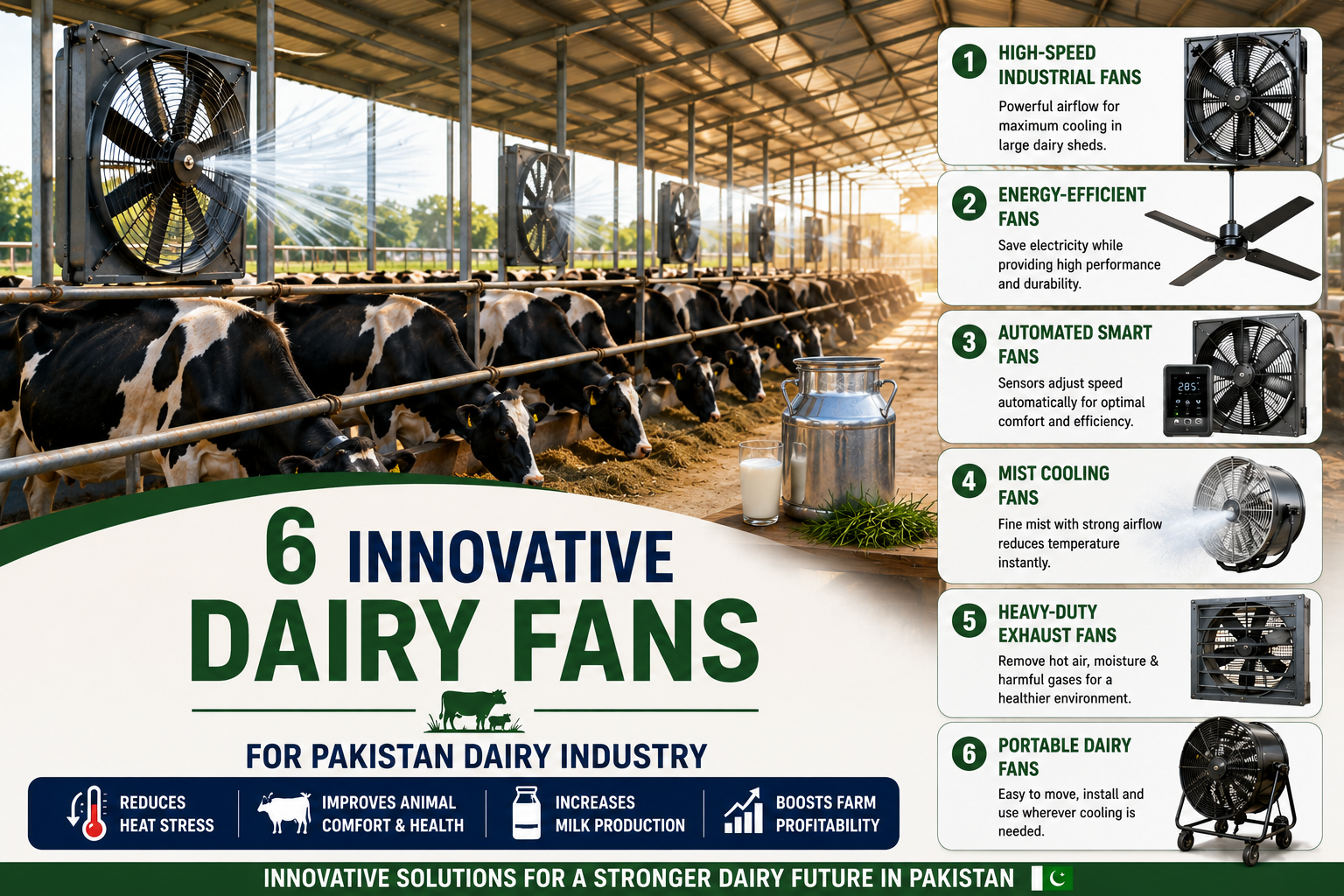
Introduction to Dairy Fans for the Pakistan Dairy Industry The dairy industry in Pakistan is a major agricultural income-generating activity and employs millions of smallholder farmers. Milk production places Pakistan among the world’s top dairy producers. Some dairy farms, however, have low production and poor livestock performance. One reason is the inadequate provision of ventilation and cooling systems on dairy farms, especially during the hot, dry summer. Hence, the Dairy Fans for Pakistan are of great importance to agriculture and the economy. Pakistan, especially Punjab and Sindh, is mostly hot and humid, with temperatures that are uncomfortable for dairy animals. Both cows and buffalo naturally produce a lot of heat, and with the high ambient temperatures, they are unable to dissipate it effectively. Consequently, heat stress, which has detrimental effects on milk yield and reproduction, and negatively affects the health of dairy animals, occurs. This problem has made the adoption of fans for dairy farming a priority for farmers. Today’s dairy fans go beyond the cooling capabilities of the past. The fans comprise multiple components designed to improve the quality of the environment for livestock. The fans can move air, reduce humidity, and remove noxious gases. Adequate air circulation keeps livestock relaxed, allows for proper eating, and increases milk production. Without proper air circulation, dairy farms will operate inefficiently and incur higher veterinary costs. In recent years, farmers in Pakistan have experienced increasing demand for dairy products. There is a growing awareness of modern farming practices. Traditional practices that focus less on animal welfare are phasing out. Modern practices include installing dairy fans, and the cost of the fans should no longer be viewed as a discretionary expense. Farmers who install dairy fan systems report improvements in milk production and increased herd health. The cost of dairy fan systems is offset by the additional benefits they provide. Farm profitability decreases livestock stress, increases milk production, and lowers farm deaths. Also, understanding the costs and prices of dairy farms in Pakistan helps farmers select affordable options and equipment suitable for their farms. The new ventilation systems being implemented on dairy farms are a prime example of how modern technologies can impact productivity and hygiene. Effective ventilation improves stall drying, helping minimize the development of pathogens and other ailments. This is especially beneficial for the Pakistani dairy sector, as maintaining cleanliness is often difficult due to environmental conditions. Overview of Pakistan Dairy Industry and Climate Challenges The Pakistan dairy industry is vital to the agricultural sector of the economy, accounts for a large share of GDP, and provides a source of income for a range of rural households. Livestock are raised not just for milk, but also play a critical role in food production and the local economy. While Pakistan is one of the largest milk-producing countries, several challenges remain in enhancing the production of high-quality, efficient dairy products. The extreme and inhospitable climate in Pakistan is the greatest concern, as it impacts livestock health and productivity. Pakistan has some of the hottest summers in the world, with many regions reaching 40 °C or higher. Furthermore, the combination of high temperatures and high levels of humidity makes it very uncomfortable for livestock. For cows and buffaloes, environmental changes are especially severe. Extreme temperatures hamper the normal biological functioning and regulation. When livestock are kept in such conditions for prolonged periods, they are at risk of heat stress, which in turn reduces appetite, slows metabolism, and drastically reduces milk output. Many traditional farmers use natural ventilation systems that do not provide sufficient airflow to refresh the air. Poor ventilation can keep barns hot and humid, creating an environment that can be dangerous for agricultural animals and workers due to ammonia gas. This is why we should incorporate dairy farm fans to improve ventilation and stabilize the environment, making the livestock more comfortable. Using high-quality dairy fan in barns will mitigate the negative effects of inclement weather. These fans are designed to prevent the air in animal shelters from becoming stagnant and accumulating heat. Proper airflow will even dry the surfaces in the barns and reduce the risk of infections and other diseases in the livestock. Ventilation systems are as important as feeding and breeding management practices in modern farms. The other factor stimulating the adoption of cooling systems in Pakistan is the awareness that Dairy Fans in Pakistan generate. Given the recent advances in information technology, dairy farmers are eager to modernize and adopt these technologies. The shift from traditional practices to modern systems will radically transform the dairy industry in Pakistan, consolidating its economic growth. Dairy farmers are concerned about economic losses from heat stress in dairy cattle. Decreased lactation and fertility, combined with added veterinary expenses, jeopardize the profitability of dairy operations. While the overhead cost of installing fans on a dairy farm is high, the benefit of avoiding these economic losses and maintaining year-round farm productivity is even greater. Additionally, knowledge of dairy farm fan prices in Pakistan helps farmers make economically justifiable decisions without sacrificing options. With the continued impacts of climate change, the costs and negative impacts of heat stress on dairy cattle have become even more pronounced. Global warming has contributed to erratic and extreme weather, making it more difficult to ensure livestock remain in optimal condition. Consequently, the adoption of dairy fan systems is increasing rapidly. Importance of Dairy Fans in Modern Dairy Farming In most parts of Pakistan, the extreme climate demands proper management of ventilation and dairy fans. As the dairy industry grows, the use of fans is increasingly required to increase productivity and efficiency. The first reason dairy fans are essential for dairy farming is their ability to maintain a safe and even temperature for dairy farm animals. Like other livestock, cows and buffaloes are sensitive to high temperatures. When livestock animals are exposed to high temperatures for prolonged periods, their bodies can no longer function as required. They eat less and lose the ability to digest food. This also causes