
Introduction
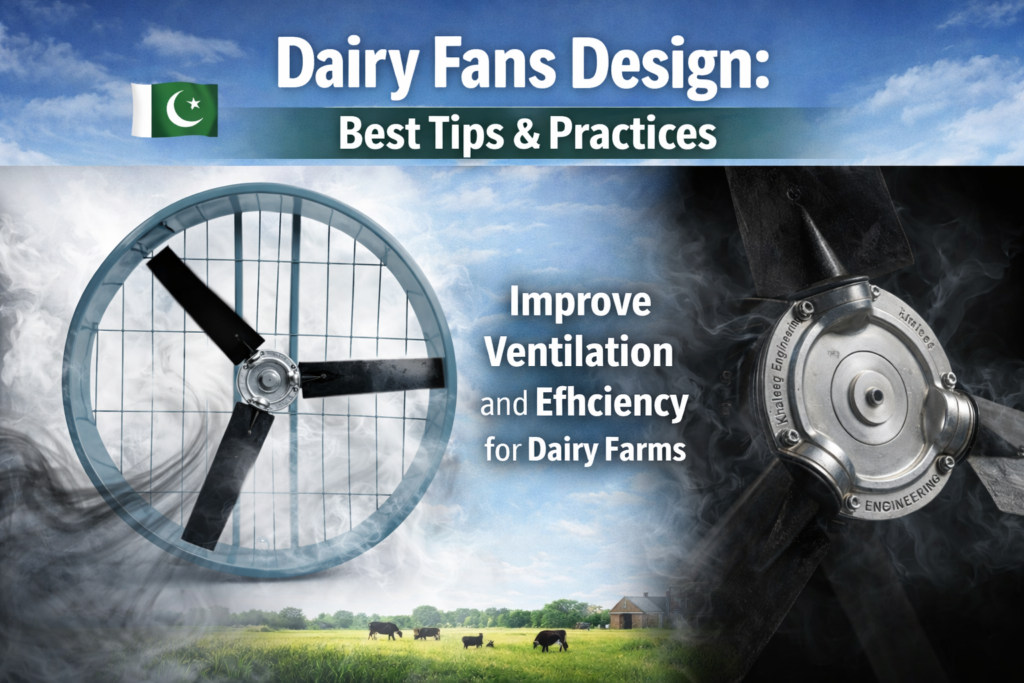
The design of dairy fans plays a very important role in modern dairy farms. A dairy farm is not simply about animals, feed, and milk production. Very important too is the atmosphere in the dairy shed. Cows, buffalo, or other dairy animals should not be kept in hot, humid, or poorly ventilated areas, as this can reduce their health and productivity. Enter dairy fans.
A good dairy fan design improves airflow, reduces heat stress, removes moisture, and creates a more comfortable environment for animals. Dairy farm design in Pakistan has become an important topic for dairy farm owners, equipment suppliers, and farm planners in hot-weather countries, especially Pakistan.
On many dairy farms, the type of fan used depends on the power supply, farm size, shed structure, and ventilation needs. Common options are Dairy fan single-phase and Dairy fan three-phase. They are both beneficial, but they are not the same thing. The choice of the right type of fan could impact energy consumption, airflow performance, maintenance cost, and long-term farm productivity.
This article explains the dairy fan’s design in a simple and practical way. You will learn how dairy fans work, why good design is important, and how single-phase and three-phase dairy fans are used on dairy farms.
What Is Dairy Fans Design?
Dairy fan design includes the planning of the type, size, location, angle, quantity, and power system of the fans used in a dairy farm. It’s not just about buying a fan and putting it somewhere. Good design considers the animals, the shed size, the roof height, the direction of airflow, the weather, and the availability of power.
Dairy fans are designed to move fresh air across the animal area. This helps to cut down heat, humidity, smell, and stagnant air. In summer, the air may not move properly and may make animals uncomfortable. Insufficient ventilation can also cause wet floors, bad smells, and unhealthy conditions in the shed.
A good dairy fans design should answer important questions such as:
- How many dairy fans are needed?
- Where should dairy fans be installed?
- Should the farm use dairy fan single phase or dairy fan three phase?
- What should be the fan direction?
- How much airflow is needed?
- How much electricity will the fans use?
- How easy will maintenance be?
These questions matter because every dairy farm is different. A small farm with limited animals may need a different system than a large commercial dairy farm.
Why Dairy Fans Design Is Important
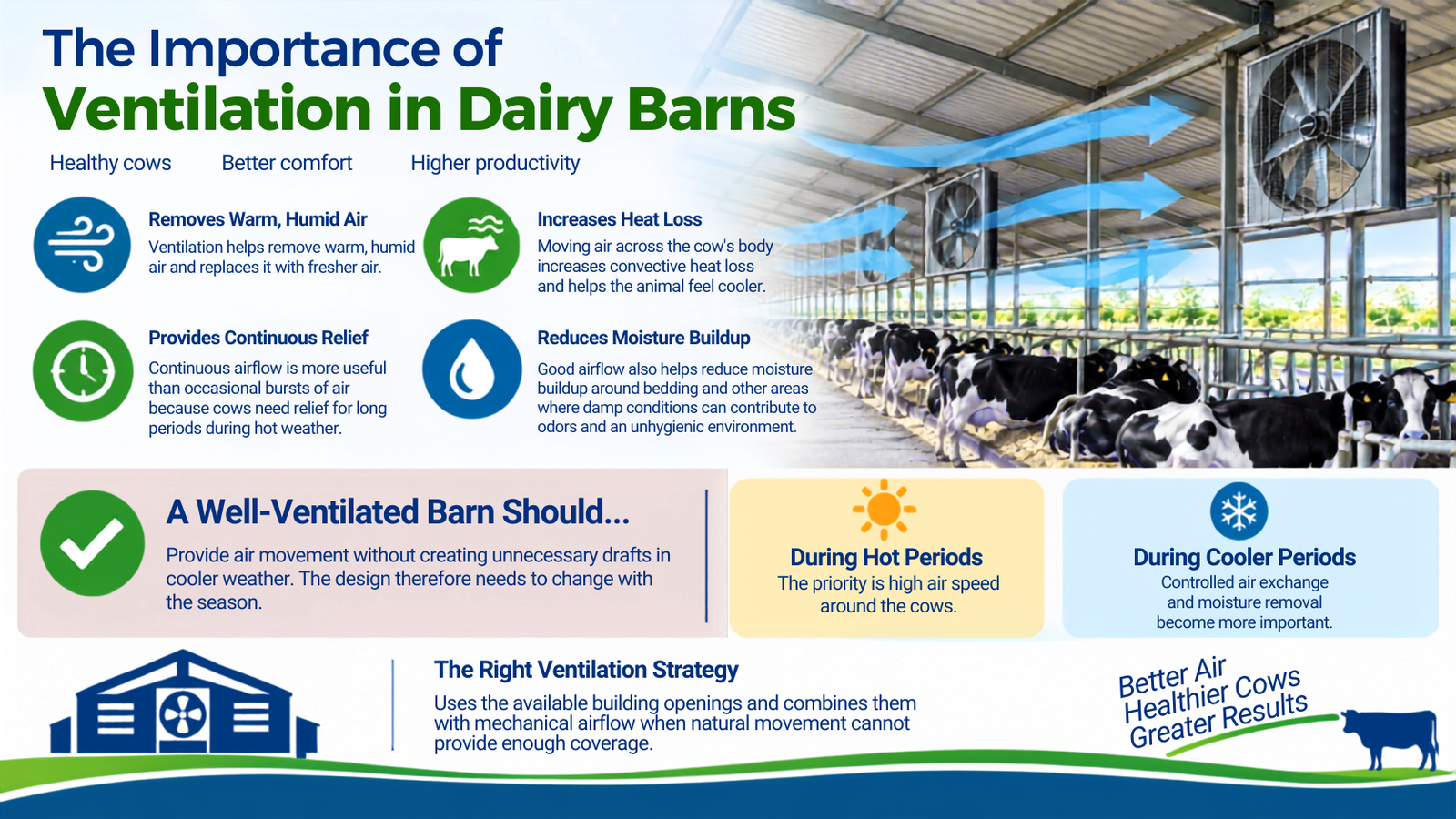
Dairy fans are important as animals can suffer from heat stress. Heat stress occurs when dairy animals’ body temperature rises and they cannot cool themselves sufficiently. This can lead to reduced milk production, feed intake, fertility, and overall health.
Dairy animals produce body heat on their own. With a lot of animals in one shed, the heat builds up very quickly. If the shed is poorly ventilated, the problem is worse. Fans for dairy lovers help move air around the animals and get rid of heat that gets stuck.
- Good dairy fans design can help with:
- Better animal comfort
- Reduced heat stress
- Improved milk production
- Better feed intake
- Lower moisture inside the shed
- Cleaner air movement
- Improved working conditions for farm staff
- Better long-term farm efficiency
This is why dairy fans design should not be treated as a small detail. It is part of the farm’s productivity system. A weak ventilation setup can quietly reduce profits every day.
How Dairy Fans Work
Dairy fans move air from one place to another. They create airflow inside the dairy shed so that hot and stale air does not linger around the animals. That blowing air helps animals get rid of body heat.
As air moves over the body, the animal is cooled by air movement and evaporation. That’s especially good when it’s hot weather. Dairy fans don’t chill the air like an air conditioner, but they do create a cooler environment by moving air around.
In simple words, dairy fans work by:
- Pulling or pushing air
- Creating steady airflow
- Reducing stagnant hot air
- Helping moisture dry faster
- Supporting better ventilation
The design of the fan, blade size, motor power, and installation angle all affect how well dairy fans work. A poorly installed fan may use electricity but fail to cool the animal area properly.
Dairy Fans Design Pakistan
The hot summers, high temperatures, and dust common to many parts of Pakistan make the dairy fans Pakistan design so important. In Pakistan, dairy farms generally require strong ventilation systems to protect animals from heat stress.
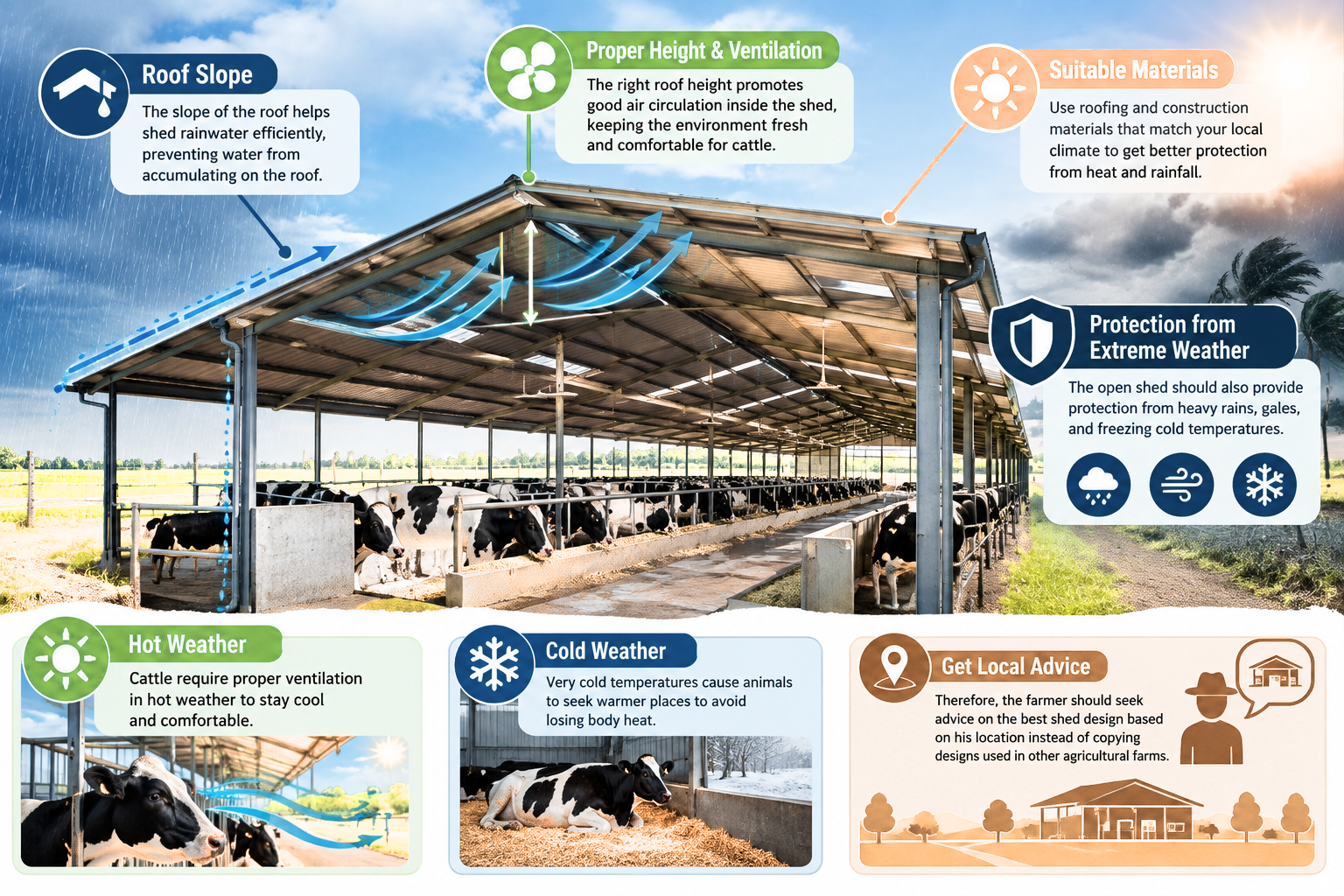
A lot of dairy farms in Pakistan are built in the form of open sheds, semi-open sheds, or traditional structures. Due to this, dairy fans’ design in Pakistan should be practical and suitable for local conditions.
- Farm owners should consider:
- Local weather
- Power supply quality
- Availability of single phase or three phase electricity
- Dust and maintenance needs
- Fan motor durability
- Shed structure
- Animal density
- Electricity cost
Single-phase is common in many small farms, as single-phase power is widely available. In bigger farms, a three-phase dairy fan might be better as three-phase motors are more efficient for heavier loads and continuous operation. The real mistake made by many farm owners is copying another farm’s fan setup without checking their own shed design. What works for one farm may not work for another. Dairy fans design in Pakistan should be based on farm size, power supply, budget, and animal comfort needs.
Dairy Fan Single Phase
A dairy fan single-phase uses single-phase energy. This type is generally used in small to medium-sized dairy farms where three-phase electricity is not available. Easy to install in many rural and semi-urban areas.
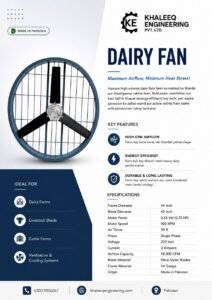
- A dairy fan single phase can be handy for small dairy
- Average dairy farms
- Single-phase power districts
- Reduced fan number configurations
- Basic ventilation requirements
- Farmers working on tight budgets
The greatest advantage of a dairy fan single phase is accessibility. Most farms already have single-phase electricity, so installation can be simpler. But single-phase fans are not always the best choice for heavy-duty, large-scale, continuous operation.
If a dairy farm has many fans running for long hours, the single phase system may face more load pressure. Motors may heat up if the design is poor or if the electrical supply is unstable. That is why dairy fans design should always include load planning.
A dairy fan single phase system should be selected carefully by checking motor quality, blade size, airflow capacity, and energy consumption.
Dairy Fan Three Phase
A dairy fan three phase uses three phase electricity. This type is commonly preferred in larger dairy farms or commercial setups where fans need to run for long periods.
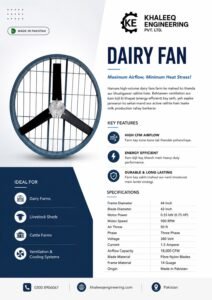
- Dairy fan three phase can be useful for:
- Large dairy farms
- Commercial dairy sheds
- Heavy-duty ventilation systems
- Multiple fan installations
- Continuous operation
- Better load balance
Three phase motors are usually more suitable for higher power applications. They often provide smoother operation, better efficiency, and stronger performance for large-scale use.
However, dairy fan three phase also requires proper electrical infrastructure. If three phase power is not available, installing it may involve extra cost. For a large farm, that cost may be worth it because better ventilation can protect production and animal health.
The key point is simple: dairy fan three phase is not automatically better for every farm. It is better when the farm size, power availability, and ventilation load justify it.
Single Phase vs Three Phase Dairy Fans
Dairy Fan Single Phase and Dairy Fan Three Phase. The choice depends on the farm condition. Both options can work, but the right option depends on scale and availability of electricity.
A single-phase dairy fan is usually better for small farms as it is easier to install and may cost less to start. Three-phase is better for large farms in general , since it can support more powerful and longer operations.
Not every small farm needs a three-phase installation. If the load is too high, a large farm should not depend blindly on single-phase fans. The best design is the one that fits the real farm needs.
For example, even a farm with a few animals and a small shed can use a dairy fan single phase with no problem. But a commercial dairy farm with many animals, long sheds, and high summer heat may need a three-phase dairy fan for better airflow performance.
That’s why dairy fans’ design should be based on proper planning and not on guesswork.
7 Dairy Fans Design Tips 1. Understand Your Shed Size First
Choose dairy fans after measuring the dairy shed correctly. You should have the length, width, roof height, and animal standing space. Shed size will dictate fan placement.
A small shed may require fewer fans; a long shed may require several fans in a line. Without measuring the space, installing fans can create uneven airflow. Some animals may get good airflow while others stay in hot spots.
Good dairy fans design begins with the shed, not the fan.
2. Select the Correct Fan Type
Then you have to select Dairy fan single phase or Dairy fan three phase. This decision should be made based on your power supply and the size of the farm.
If your farm is small or medium and only single-phase electricity is available, select a dairy fan single phase. If you have a bigger farm that requires strong, constant ventilation, then go for a dairy fan three-phase.
Do not base your choice on price alone. Cheaper fans that perform poorly can cost more in the long run due to poor animal comfort, higher maintenance, and reduced productivity.
3. Put Fans Where Animals Spend the Most Time
Dairy fans should be located where animals are standing, resting, eating, or waiting to be milked. Installing fans in empty spaces is a waste of electricity.
The key areas are:
Feeding Grounds
Place of rest
Waiting area for milking
Shed area covered
Animal high-density zones
The idea is to get air moving over the animals, not just around the roof. Fans installed too high or at the wrong angle may not create useful airflow at the animal level.
4. Adjust the Fan Angle Correctly
Fan angle is very critical in dairy fan design. If the fan is turned up too high, the air may not get to the animals. If it is pointed too low, it can be uncomfortable or blow dust right at you.
A common practical design directs airflow over the area of the animal’s body. The fan should be able to maintain a constant rate of air movement through the shed.
The right angle depends on fan size, the height of the shed and where it’s installed. That is the danger of random installation. A good fan with bad placement can act like a bad fan.
5. Don’t fall into dead air zones
Dead air zones are where the air doesn’t flow well. These places become hot, humid, and miserable. Animals might avoid such places or, if forced to stay, suffer in silence.
Dairy fans should be spaced properly to avoid dead air zones. The airflow from one fan should be helping the next area, not fighting it.
Poorly designed dairy fans cause uneven airflow. One side of the shed might be cool and another side hot. That is not efficient, and it is not fair to the animals.
- Plan Electricity Load Properly
Electricity planning is very important, especially when using multiple dairy fans. A dairy fan single-phase setup should not be more than the electrical system available. A three-phase setup for a dairy fan should be properly wired, protected, and load-balanced.
Poor electrical planning can lead to:
- Engine heating
- Voltage loss
- Reduced fan speed
- More maintenance
- Electrical faults.
- Reduced motor lifespan
This is especially important for farms in Pakistan where power quality can vary by location. Dairy fans design in Pakistan should always take into account the local electricity conditions.
7. Make Maintenance Easy
Fans require cleaning and maintenance. “Dairy farms can be dusty and moist, and have animal waste in the environment. Over time, the fan blades and motors can pick up dirt. This degrades the performance. A good dairy fan design should make maintenance a breeze. Fans should be accessible for safe cleaning, inspection, and maintenance.
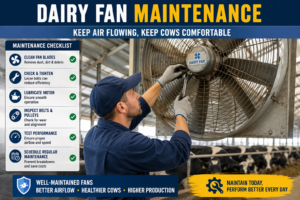
Farm owners should check regularly:
- Blades of a fan
- Motor status
- Cables
- Mounting points
- Vibration or noise
- Performance of Airflow
Skipping maintenance is a costly mistake. A damaged or dirty fan may pull power but produce weak airflow.
Design Errors in Common Dairy Fans
Many dairy farms put fans in and still have heat and ventilation issues. This is usually because of poor design.
Common errors are:
- Not enough fans installed.
- Fans are mounted too high.
- Wrong fan type.
- Overlook Power Loading
- Bad fan angle
- No maintenance schedule
- Copying blindly another farm
- Not verifying animal comfort
- Bad quality motors are used
- Ignoring shed construction
The biggest mistake is to think that any fan will do. Dairy fans aren’t just household fans kept on a farm. They are part of a farm ventilation system .A serious dairy farm owner would consider ventilation as an investment, not an expense.
Is Dairy Fans Design Good for Small Farms?
Yes, the dairy fans’ design is useful even for a small farm. A small farm may not require a complicated system, but it does require good airflow.
Dairy fan single phase is good for a small farm because it is easier to install and good for basic ventilation. The design should focus on the most important animal areas, such as feeding and resting zones.
Small farms usually work on tighter budgets, so every rupee counts. The smart dairy fan design can improve animal comfort without wasting electricity.
The trick is not to overdesign or under design. Use what the farm really needs.
Dairy Fans Design Good for Big Farms?
Yes, the design of the dairy fans is very important to large farms. “Most of the time, big dairies have more animals, more heat build-up and more ventilation problems.”
Dairy fan three-phase is more practical for large farms, as several fans may need to run for long hours. Three-phase systems can handle heavier loads more effectively if properly designed.
Large farms should pay attention to airflow mapping, too. That means looking at air flow throughout the whole shed, not just around one fan.
In large operations, bad ventilation may cause large losses since many animals are affected at the same time. Well-designed dairy fans help protect milk production, animal comfort, and farm efficiency.
Design for Dairy Fans and Animal Comfort
The primary purpose of dairy fans is for the comfort of the animals. Comfortable animals eat better, rest better, and produce better. Heat stress in animals usually results in reduced eating and reduced productivity.
Fans help keep animals cooler by increasing airflow. Dairy fans, this is very important, especially in summer and in humid weather.
Signs of poor airflow in animals are:
- Breathe deeply
- Prolonged standing
- Less fodder
- Assembly in the open air
- Poor sleep habits
A farmer should watch animal behavior. Ventilation problems often show up in animals before they show up in machines.
Milk Production and Design for the Dairy Lover
The Dairy fans design can help the milk production indirectly. When animals feel comfortable, they are more likely to show normal feeding and resting behavior. These two factors are closely related to milk production.
The heat stress can reduce production because the animal has to use more energy to regulate body heat. Better airflow helps relieve that stress.
That’s not to say that a fan by itself will increase milk production overnight. Also, matter feed quality, genetics, water, health, and management, but ventilation is one of the important supporting systems.
Neglecting dairy fans’ design can silently destroy production potential.
Dairy Fans Design Pakistan: Practical Tips for Buying
For design, Pakistani dairy fans’ buyers should think realistically. Don’t just ask for the cheapest fan. Ask if the fan will fit on your farm.
Important buying points are:
- Size of the fan
- Type of motor
- Single or three-phase
- Blade quality
- Airflow power
- Use of electricity
- Noise level
- Maintenance assistance
- Longevity
- Guarantee
“A good dairy fan should fit the environment of the farm.” Pakistan’s dairy farms may encounter heat, dust, voltage fluctuations and heavy use. So durability is important.
Cheap equipment can be costly when it quits in the heat of summer.
Dairy Fan Single Phase: Best Use Cases
Dairy fan single phase is best for farms that need simple ventilation and have limited electrical infrastructure.
Best use cases include:
Small dairy sheds
Medium farms
Farms with fewer fans
Areas without three phase electricity
Basic cooling needs
Lower initial budget
However, the farm owner should not overload single phase wiring. If many fans are added later, the system may need upgrading.
A smart approach is to plan future expansion early. Even if you start with dairy fan single phase, keep space and wiring planning flexible.
Dairy Fan Three Phase: Best Use Cases
Dairy fan three-phase is better for heavier farm requirements. Appropriate where higher motor performance and continuous operation are needed.
Best use cases are as follows:
Big dairy sheds
Commercial farming.
Multiple fan arrangements.
Long operating time
High heat regions
Heavy-duty ventilation design
Dairy fans should be installed by a professional on a three-phase system. Poor wiring or weak protection can create safety and maintenance issues.
For serious commercial farms, three-phase planning can be a good decision in the long term.
How to Improve the Existing Design of Dairy Fans
If you have fans on your farm but the airflow is still not strong, you may not need to change everything immediately. First, look at the current design.
Look at these things
- Is the blower clean?
- Are the motors working right?
- Are fans leveled correctly?
- Is the fan spacing too big?
- Are the animals getting the airflow?
- Is the power supply stable?
- Are there any dead air spots?
Sometimes a bit of change is good for performance. Motor repair or adding a fan in a weak zone can help a lot . Blade cleaning and angle adjustment can make a big difference. Don’t assume the fan is bad without checking the design.
For dairy lovers: The Energy Efficient Design
The significance of energy efficiency is that fans can run for many hours in hot seasons. Poor fan selection can increase electric bills without providing the proper airflow.
To enhance the energy efficiency:
- Choose the right fan size.
- Skip the unnecessary fans.
- Set up fans correctly
- Keep blades and motors
- Fan type matches the power supply
Use a dairy fan three-phase where a heavy load calls for it
Single-phase dairy fan, if applicable only
Energy efficiency isn’t just about using fewer fans. It’s about using the right fans, the right manner.”
A well-designed system will perform better and waste less electricity.
Design & Farm Profit Dairy Fans
In several ways, good dairy fan design can affect farm profit. It can also mitigate heat stress, improve animal health, increase comfort, and protect production. It can also cut down on unnecessary electricity waste.
Bad design creates hidden losses. “Money can be spent on fans and electricity, but comfort may not be created.”
This is why farm owners should think from first principles: the fan is not the end goal. You want to get airflow at the level of the animal.
If the fan does not improve animal comfort, a design correction is needed.
Final Comments
Dairy farm design is an essential part of the management of dairy farms. It helps to increase the air flow, reduce heat stress, and create a healthier environment for dairy animals. Whether you are designing dairy fans in Pakistan, selecting a dairy fan single phase, or doing a dairy fan three-phase installation, the main objective should be animal comfort and efficient ventilation.
Simple single-phase systems can work well for small farms. Larger farms may require more powerful 3-phase systems. But in both cases, good planning is more important than random installation.
A good design for dairy fans should consider the size of the shed, position of the fan, direction of airflow, electricity load, maintenance, and local conditions. When well-managed, dairy fans can be a good investment in long-term dairy farm performance.
But the brutally honest point is this: Buying fans without proper design is not a strategy. It’s guesswork.” And guesswork in dairy farming can cost you money every single day.
For better results, start with the shed, know the animals, check the power supply, and design the airflow properly. That’s how dairy fans become useful, efficient and profitable.
FAQs
- What is dairy fans design?
Dairy fans design is the planning of fan type, size, placement, angle and power system for proper airflow in a dairy far.
- Why is dairy fans design important?
The importance of dairy fans design is that it helps to reduce the heat stress, improve animal comfort and support better dairy farm conditions.
- What is dairy fan single phase?
Dairy fan single phase is a single-phase, electricity-operated dairy fan . It is often used in small and medium-sized dairy farms.
- What is dairy fan three phase?
A 3-phase dairy fan is a dairy fan that is used on three-phase electricity. It is commonly used in large or commercial dairy farms.
- Which is better: dairy fan single phase or dairy fan three phase?
Dairy fan single phase is better for smaller farms Dairy fan three phase is generally better for larger farms with heavier ventilation needs
- Is dairy fans design pakistan different?
Yes, dairy fans design in Pakistan should take into account local heat, dust, power supply, farm structure, and electricity cost.
- How do dairy fans work?
This may help reduce heat stagnation and encourage better ventilation.
- Can dairy fans improve milk production?
Of course, dairy fans contribute to animal comfort and reduce heat stress of animals, which can help improve milk production.
- Where should dairy fans be installed?
Basically, dairy fans should be installed where animals spend the most time, such as in in feeding and resting areas and in covered shed zones.
- What is the biggest mistake in dairy fans design?
The worst mistake is putting fans in without a proper plan. Fan angle, placement, power load and airflow direction all matter.





1 Comment
[…] axial fan air flow calculation is an important step before selecting a ventilation system. It helps determine the correct fan […]